“I love sleep. My life has the tendency to fall apart when I’m awake, you know.”
~ Ernest Hemingway
Perhaps the most cherished item in a hiker’s kit. After a long day on the trail is there anything better than crawling into a warm sleeping bag (or quilt) and drifting off to Mother Nature’s wondrous soundtrack? Intangibles aside, it’s important to have a sleeping bag that meets both your own individual needs and the dictates of the environment into which you are venturing. Consider the following points:

Mike “The Gambler” Towne using a combination of the Western Mountaineering Ultralite sleeping bag and the Katabatic Gear Bristlecone Bivy | SW Horseshoe, Utah, 2012.
Down Vs Synthetic
Generally speaking down bags have a better warmth to weight ratio, last longer and are more compressible than their synthetic equivalents. The primary negative commonly associated with them is that they are useless when wet. I’ve always felt this backpacking “truism” to be overly dramatic. The fact is, it takes quite a lot to completely soak the insulation of a sleeping bag. We’re talking getting slam-dunked during a river crossing or standing underneath a waterfall. The occasional bit of transferred moisture from the inner wall of your tent or tarp doesn’t do too much harm, and will generally dry out pretty quickly if you lay your bag out in the sun during a midday break.
The key is simply to take some basic precautions in order to keep your bag dry. Line the inside of your backpack with a garbage/trash compactor bag. If you know you have some pretty serious river fords coming up, put your down items (along with electronics) in a separate dry bag inside your liner. Prevention is better than cure.
The Rating Game
Just because a company claims that a bag is rated to “X” ° Celsius / Fahrenheit, doesn’t necessarily make it so. Traditionally such ratings tend to be a little on the high side of your average person’s reality. For example, a -9°c / 15° F bag that leaves you shivering when the temperature is hovering around freezing.
Fortunately, in recent years companies such as Katabatic Gear have joined long time market leaders such as Feathered Friends, Western Mountaineering and Marmot, in placing a higher emphasis on accuracy when it comes to rating their products. Before purchasing your sleeping bag, scour the internet for as many reviews as possible. It won’t take long for you to discover whether the bag you are looking at is everything it is made out to be by the manufacturers.
It is worth noting that generally speaking, women tend to sleep 5 to 10 degrees colder than men.

Marmot Helium 15 F (-9 C) – 900 Fill Power
Warm or Cold Sleeper?
Everyone is different. Often a sleeping bag’s rating may be spot on for a “warm sleeper” but may leave a “cold sleeper” wishing they had upgraded to a warmer bag. Before shelling out big bucks on an expensive sleeping bag, it pays to have an idea where you are situated on the scale of warm to cold sleepers. For example, if winter is approaching and you are still sleeping in shorts and a t-shirt while everyone else around you has broken out the heavy-duty thermal underwear, chances are you are a warm sleeper.
Two For One
If most of your hiking is done with a spouse or partner, it may be a good idea to buy bags with compatible zippers. That is one with a left-hand zip and one with a right-hand zip. The shared body heat will increase the warmth factor considerably.
If you would like to take things a step further and save even more weight, you and your partner may consider investing in a 2 person quilt (see The Big Three in GOING LIGHT). However, before making such a purchase, take a moment to think. A double quilt may be fine for “cuddly” sleepers, but not so good for those who need their own space. Definitely steer clear of this option if your partner is a “blanket” hoarder.

Montbell Down Hugger (800 fill power)
Shape & Size
When it comes to sleeping bags, most hikers go for mummy models, which are wider at the top and taper in towards the bottom. However, if you are a restless sleeper who tends to move around a lot, you might consider buying a wider bag. You really can’t put a price on a good night’s sleep. Note that roomy bags mean more airspace, which in turn translates to loss of warmth.
You Get What You Pay For
While most lightweight hiking gear is less expensive than its heavier equivalents, the opposite is true of sleeping bags (and all down products, for that matter). A good down sleeping bag is not cheap.
One factor which provides a clue as to the bag’s quality is its fill power. Basically, a high fill power (eg. 800+) equates to better quality down, which means superior insulation and warmth to weight ratio. In real terms, upgrading from a down bag with 600 fill-power to one with 800 fill-power, both of which have the same temperature rating, can mean a weight saving of up to 300grams (10.6 ounces). The catch? Bags with higher fill powers are more expensive.
Sleeping Bag Liner
They keep the inside of your sleeping bag cleaner and add up to 5 degrees of warmth. Personally I don’t carry one when I am hiking. I would rather utilize the extra weight to bring along a beanie and a warm thermal top that will keep me toasty inside my bag and be useful outside as well.
Zipper
I recommend full-length zippers over their half-sized equivalents, as this gives you the option of using your bag as a quilt when temperatures are warmer.
Hood & Neck Collar
A large amount of body heat is lost through our heads. An insulated collar and a well-contoured hood make for a warmer sleep. Alternatively, a beanie and shirt wrapped around your neck should do the trick.
Insulation from the Ground
Keep in mind that a sleeping bag, no matter how warm its rating, will not be able to perform to its optimum level without adequate insulation from the ground. In cold weather, a sleeping mat is vital in preventing your body temperature from dropping due to conductive heat loss to the ground. See the Sleeping Mat section for more details.
Sleeping Bags Vs Sleeping Quilts
From the 1980s through to 2003, I exclusively used sleeping bags. From 2003 to 2011, I tried a couple of different types of quilts, but being a side sleeper who occasionally tosses and turns, I was never entirely satisfied with the attachment systems. As a result, I invariably found myself returning to the simplicity and reliability of a mummy sleeping bag.
Finally in 2011/12, after trying quilts from a relatively new Colorado-based company by the name of Katabatic Gear, I made the full-time switch from bags to quilts. More than 1000 nights in the wilderness later, I suspect there is no going back. For the full skinny on why you might consider quilts see the following article: Why Choose a Quilt over a Sleeping Bag?
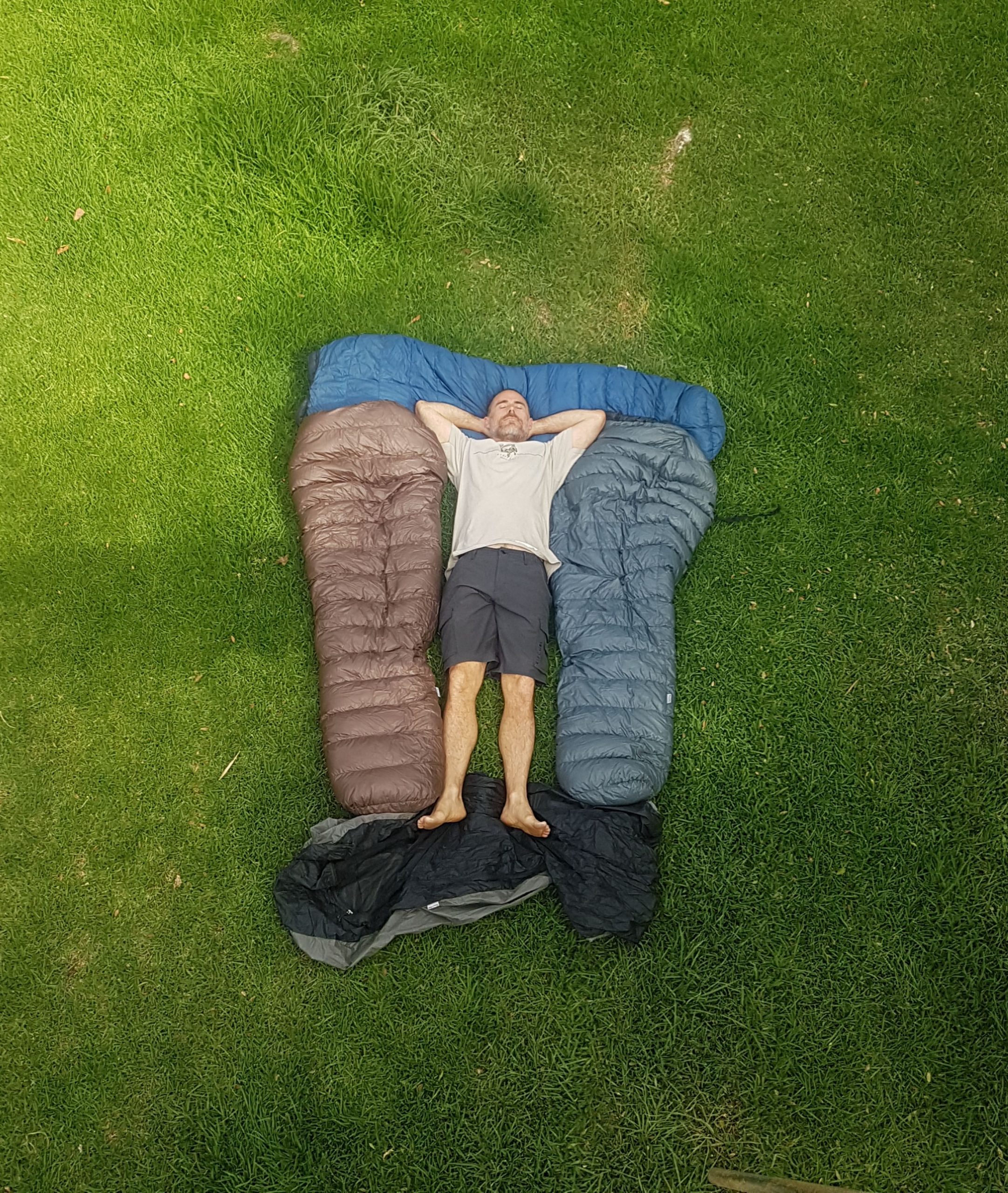
Three Katabatic quilts (Alsek, Sawatch and Palisade). Nine years. 1000 plus nights. 20,000 plus miles (32,187 km).
Recommended Sleeping Bags
- Feathered Friends Hummingbird UL 20 (-6.7°C)
- Feathered Friends Swallow UL 20 (-6.7°C)
- Marmot Helium 15°F (-9°C)
- Montbell Down Hugger 900 #2 25°F (-4°C)
- Montbell Down Hugger 800 #1 15°F (-9°C)
- Patagonia 850 Down Sleeping Bag 19°F (-7.2°C)
- RAB Mythic 400 (19.5°F / -6.9°C // 900 Fill)
- Western Mountaineering Ultralite 20°F (-6.7°C)
- Western Mountaineering Megalite 30°F (-1.1°C)
- Western Mountaineering Badger 15°F (-9°C)
Budget Options
Recommended Quilts
- Enlightened Equipment Enigma 20°F (-6.7°C)
- Jacks R’ Better Sierra Sniveller 25°F (-4°C)
- Katabatic Sawatch 15°F (-9°C)
- Katabatic Alsek 22°F (-5.6°C)
- Katabatic Flex 22°F (-5.6°C)
- Katabatic Palisade 30°F (-1.1°C)
- Nunatak Arc UL 20°F (-6.7°C)
- ZPacks 20°F (-6.7°C)
Related Articles: